Welcome
A quiet suburb with a famous address
Cupertino sits at the western edge of the Santa Clara Valley, about 10 miles west of downtown San José. For most of the 20th century it was orchard country, with prunes, apricots and cherries on almost every acre. Then came the subdivisions, a community college, and in 1977 a small computer company that never left.
Visitors expect a tech theme park. What they find is a calm, car-friendly town with something better: oak-covered foothills 15 minutes from Apple's front door, two historic wineries up a mountain road, and a long list of Chinese, Taiwanese and Korean restaurants tucked into ordinary-looking shopping centers.
Read the full history of Cupertino →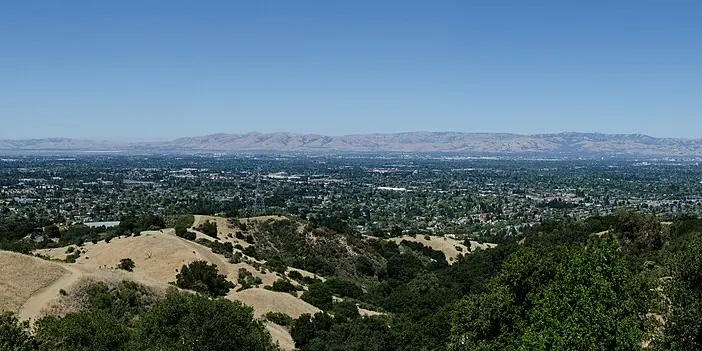
Explore by interest
Everything Cupertino, in one place
Top picks
The places worth your time
 Apple
 Hike
 Wine
 Water
 Food
 History
Book early
Only seven hotels in town
Weekday business travel and Apple events fill Cupertino's rooms fast. Compare prices now, then read our area-by-area guide.
Itinerary
One perfect day in Cupertino
- Beat the crowds at Rancho San Antonio
Park early and walk the flat mile to Deer Hollow Farm. Fit hikers keep climbing on the Wildcat Loop.
- Apple Park Visitor Center
Head straight to the roof terrace, then browse the Apple Park merchandise most Apple Stores don't carry.
- Lunch at Cupertino Village
Ramen, claypot rice or Korean fried chicken, then bubble tea for the road.
- Apple history drive
See Infinite Loop, Bandley Drive and the 1977 office on Stevens Creek Boulevard from the street.
- Up Montebello Road
A short walk at Picchetti Ranch, or a booked tasting at Ridge with views over the valley.
- Dinner at Main Street
Steak, dim sum or hot pot, then dessert. Free parking garage next door.
A short history
From a creek name to Apple Park
Pedro Font names the Arroyo San José de Cupertino, today's Stevens Creek.
John T. Doyle names his winery the Cupertino Wine Company.
Phylloxera ruins the vineyards. Fruit orchards take over.
Cupertino becomes Santa Clara County's 13th city.
De Anza College opens on the old Baldwin estate.
Apple moves into a small office on Stevens Creek Boulevard.
The Macintosh is unveiled at the Flint Center.
Apple opens its Infinite Loop headquarters.
Apple Park opens. The Visitor Center follows in November.
Get your bearings
Cupertino at a glance
Apple's world sits on the east side near Interstate 280. The hills, trails and wineries are to the west and south. Highway 85 runs down the middle.
- Apple and tech history
- Parks and trails
- Food and shopping
- Wine
Schematic map, not to scale.
Plan your trip
Getting here and getting around
Good questions
Cupertino FAQ
Can you visit Apple Park?
You can visit the Apple Park Visitor Center at 10600 North Tantau Avenue for free. The campus itself, including the ring building and the Steve Jobs Theater, is closed to the public. Read more.
Is Cupertino worth visiting?
For Apple fans, hikers and food lovers, yes. Plan a full day: the Visitor Center, a foothill walk and dinner at Main Street or Cupertino Village. There's no historic downtown, so don't come expecting one.
Do I need a car in Cupertino?
Mostly, yes. There's no train station, and the trailheads and wineries are up winding roads. Rideshare works for short Apple-focused visits. Getting around.
Where should I stay?
Near Wolfe Road for Apple Park, at Main Street to walk to dinner, or on De Anza Boulevard for De Anza College. Compare all seven hotels.
Is Cupertino a good place to live?
Families come for the public schools and the hills, but housing costs are among the highest in the country. Living in Cupertino.
Photo credits
- The view over Cupertino and the valley from Hunters Point: Photo: Minyoung Choi from Cupertino, CA, USA, CC BY-SA 2.0, via Wikimedia Commons
- Looking over Silicon Valley from Fremont Older: Photo: iTod47, CC BY 2.0, via Wikimedia Commons
- Apple Park and the streets around it: Photo: Daniel L. Lu (user:dllu), CC BY-SA 4.0, via Wikimedia Commons
- Steamed dumplings, a staple of Cupertino's Chinese restaurants (stock photo): Photo: NeoBatfreak, CC BY-SA 4.0, via Wikimedia Commons
- Le Petit Trianon, home of the California History Center at De Anza College: Photo: Elan5, CC BY-SA 3.0, via Wikimedia Commons
- A ridge trail in Fremont Older Open Space Preserve: Photo: iTod47, CC BY 2.0, via Wikimedia Commons
- Cupertino Civic Center: Photo: Robert Kim/City of Cupertino, CC BY-SA 4.0, via Wikimedia Commons
- A Via-run Cupertino Rides van: Photo: AndyEdits, CC BY-SA 4.0, via Wikimedia Commons
- Santa Cruz Beach Boardwalk: Photo: Nick Amoscato, CC BY 2.0, via Wikimedia Commons
- The roof terrace at the Apple Park Visitor Center: Photo: FASTILY, CC BY-SA 4.0, via Wikimedia Commons
- The barn at Deer Hollow Farm, about a mile in from the trailhead: Photo: Runner1928, CC BY-SA 3.0, via Wikimedia Commons
- Morning fog over the Monte Bello vineyard: Photo: Agne27, CC BY-SA 3.0, via Wikimedia Commons
- Stevens Creek Reservoir in Stevens Creek County Park: Photo: Wizz4prep, CC BY-SA 4.0, via Wikimedia Commons
- The sign at 1 Infinite Loop, Apple's headquarters from 1993: Photo: Nurmib at English Wikipedia, CC BY 3.0, via Wikimedia Commons


